
Menopause Blood Tests: What They Show and When You Need One
If you're reading this, chances are something in your body has started to feel different. Perhaps your periods have become unpredictable, you're waking at 3am drenched in sweat, or your mind feels foggy in a way that isn't like you. You may have found yourself wondering: Is this menopause? Can a blood test tell me?
Menopause blood tests are one of the most common things women ask us about. The honest answer is a little more nuanced than a simple yes or no, so let's take it step by step, gently and clearly.
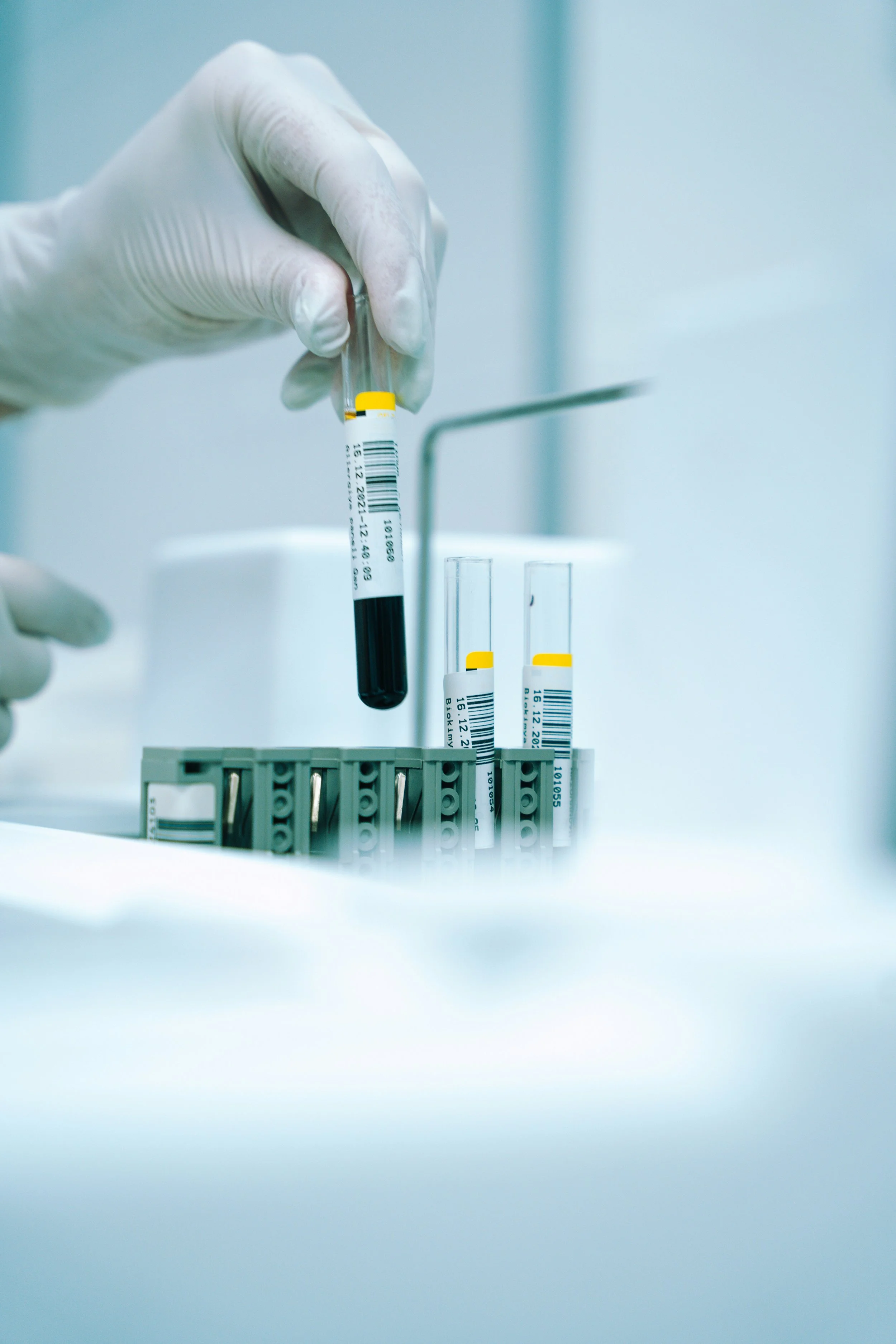
Can a blood test diagnose menopause?
For most women, no. Menopause is usually diagnosed from your age, your symptoms and changes to your periods, not from a blood test.
Menopause is defined as having gone 12 months without a period (or, if you've had a hysterectomy or are on certain contraception, it's judged from your symptoms and history). Perimenopause, the transition leading up to it, can last several years. During this time your hormones don't simply decline in a neat, steady line. They fluctuate, sometimes dramatically, from one week or even one day to the next.
That's why a single blood test can be misleading. You might have a "normal" result on a day when your hormones happen to be high, even though you're struggling with real, disruptive symptoms. Your experience matters more than a number on a page.
That said, blood tests do have an important place in certain situations, and we'll walk through those below.
Which hormones are tested?
When we do test for menopause, we typically look at three key hormones:
FSH (follicle-stimulating hormone). This is the hormone your brain sends to prompt your ovaries to release an egg. As your ovaries become less responsive, your brain "shouts louder" by producing more FSH. A persistently raised FSH can suggest the ovaries are winding down.
Oestradiol. This is the main form of oestrogen produced by your ovaries. Levels tend to fall as menopause approaches, though during perimenopause they can swing up and down unpredictably.
LH (luteinising hormone). LH works alongside FSH in the menstrual cycle and often rises as ovarian function declines. It's sometimes measured alongside FSH, though it's usually less informative on its own.
Taken together, these results can build a picture, but they're only one piece of a much bigger puzzle.
Thyroid, ferritin and vitamin D: why we test them too
Here's something many women find reassuring: menopause is not always the whole story. Many symptoms of the menopause transition overlap with other, very treatable conditions. Tiredness, low mood, hair thinning, poor sleep, palpitations and brain fog can all have other causes.
That's why we often recommend a broader panel alongside hormone testing:
Thyroid function (TSH and thyroid hormones). An underactive or overactive thyroid can mimic menopause almost perfectly, causing fatigue, weight changes, anxiety, feeling too hot or too cold, and irregular periods. Thyroid problems are also more common in midlife, so it's worth ruling them out.
Ferritin (your iron stores). Heavy or prolonged periods are common in perimenopause, and low iron can quietly drain your energy, worsen brain fog, and contribute to hair loss and breathlessness. Ferritin can be low even when your haemoglobin looks normal, so it's a valuable test if you're feeling exhausted.
Vitamin D. Vitamin D supports bone health, which becomes especially important as falling oestrogen affects bone density. Low vitamin D is also very common in the UK, particularly through the darker months, and can contribute to aching muscles, low mood and tiredness.
Testing these isn't about finding fault. It's about making sure that nothing treatable is being overlooked, so that you feel as well as you possibly can.

When blood tests are useful, and when they aren't
Our approach follows NICE (National Institute for Health and Care Excellence) guidance, which is designed to protect you from unnecessary tests and unnecessary worry.
Blood tests are generally not needed if:
You are over 45 and have typical menopausal symptoms. In this group, NICE advises that perimenopause and menopause can be diagnosed from your symptoms alone, without a blood test.
You are taking the combined oral contraceptive pill or another hormonal treatment. Hormone levels are unreliable in these circumstances, so FSH testing won't give a meaningful answer.
You simply want to start HRT. You do not need a blood test to be prescribed it.
Blood tests can be helpful if:
You are aged 40 to 45 and have menopausal symptoms or changes to your periods. An FSH test can be considered here.
You are under 40 and there's a concern about premature ovarian insufficiency (sometimes called premature menopause). Here, testing is important, because an early diagnosis matters for your long-term bone and heart health, and for fertility conversations.
Your symptoms are unusual, or there's a possibility of another cause, such as a thyroid problem or iron deficiency.
You would like reassurance and a clearer picture, having spoken it through with a clinician.
If you've been told, "You're too young for menopause," or "your bloods are normal so it can't be that," please know that neither statement tells the full story. Symptoms deserve to be taken seriously, whatever your age.
How to read your menopause blood test results
It's completely natural to want to look at your results and decode them yourself. Here is a general guide, but please remember that results should always be interpreted alongside your symptoms, your age and your medical history.
FSH. Levels above roughly 30 IU/L can suggest the ovaries are slowing or have stopped working, but during perimenopause FSH can bounce between normal and raised. A single high reading doesn't confirm menopause, and a normal one doesn't rule out perimenopause.
Oestradiol. Low levels may be consistent with menopause, but because this hormone swings so much in perimenopause, the number alone can be unhelpful.
LH. Often raised after menopause, but rarely used as the deciding factor.
Thyroid, ferritin and vitamin D. These have clear reference ranges, and if a result is outside the normal range, it usually points to something we can treat directly, whether that's thyroid medication, iron replacement or vitamin D supplements.
The most important thing to remember is this: a result is a clue, not a verdict.
Why do hormone levels sometimes need repeat testing?
Because your hormones aren't static. In perimenopause especially, they rise and fall from cycle to cycle, and even across a single month. One sample captures just one moment.
If we're investigating possible early menopause, we usually repeat the FSH test several weeks later to see whether the raised level is consistent. Repeat testing isn't a sign that something has gone wrong. It simply gives a more reliable and accurate picture, so that any diagnosis, particularly one as significant as early menopause, is made with confidence.
Getting a private menopause blood test in Wimbledon
If you'd like answers without a long wait, a private menopause blood test can be arranged at Wimbledon Medical Service. Many women choose this route because they want:
Prompt appointments and faster results
Unhurried time to talk through their symptoms with a clinician
A wider panel of tests in one visit, including thyroid, ferritin and vitamin D
Clear explanations, so results never feel confusing or frightening
If you're concerned about your symptoms, please book a consultation here or write to reception@wimbledonmedicalservice.com for any question.
What happens after your results?
Once your results are back, the next step is a conversation, not just a printout. We'll go through what your numbers mean for you and, importantly, connect them to how you're actually feeling.
Depending on your results and symptoms, this might include:
Discussing HRT. Hormone replacement therapy can be life-changing for many women, and we'll explain the benefits, the risks and the different forms available (patches, gels, tablets), so you can make an informed choice.
Non-hormonal options. If HRT isn't right for you, or you'd prefer not to use it, there are other effective treatments and lifestyle strategies.
Treating other causes. If a thyroid issue, low iron or low vitamin D has come to light, we'll address this directly.
Looking after your long-term health. This includes bone health, heart health, sleep, mood and wellbeing.
You deserve to feel heard, supported and informed at every stage.
Do you need blood tests once you're already on HRT?
Once you've started HRT, most women don't need routine blood tests. For standard oestrogen replacement, we usually judge how well it's working by how you feel — whether your symptoms have settled, and whether any side effects suggest the dose needs adjusting.
That said, there are times when we may suggest a blood test while you're already on treatment:
To check your hormone levels. If your symptoms haven't improved despite a dose increase, a blood test can help us see whether your oestrogen levels are actually rising as expected.
To check absorption. Not everybody absorbs patches, gels or tablets in the same way. If your levels are lower than we'd expect for your dose, this can point to an absorption issue, and we may suggest changing the method, the dose, or how the treatment is applied.
Testosterone is a slightly different story. It isn't licensed for women in the UK, but it can be considered, off-license, for persistent low libido that hasn't improved with oestrogen alone. Because of this, we're more cautious with testing around it:
Before starting, we check that your testosterone is actually low. Testosterone replacement shouldn't be started on the basis of symptoms alone — a baseline blood test helps confirm there's a hormonal reason to treat, rather than another cause for low libido.
After starting, we recheck your levels, usually a few months in, to make sure they've settled within the normal range for women. This matters both to confirm the treatment is working and to avoid levels running too high, which can bring unwanted side effects such as acne or excess hair growth.
As with everything else in this article, blood tests here are a tool to guide the conversation, not a box-ticking exercise. If you're on HRT and wondering whether a test might help, it's worth raising with your clinician.
Frequently Asked Questions
-
Sometimes it can offer supporting evidence, but it isn't usually needed. If you're over 45 with typical symptoms, menopause or perimenopause is normally diagnosed from your symptoms alone. Blood tests are most useful for women under 45, or where another condition may be involved.
-
An FSH level consistently above around 30 IU/L can suggest menopause, but this needs to be interpreted with your age, symptoms and cycle history. In perimenopause, FSH can fluctuate, so one result isn't definitive.
-
No. If you're over 45 and have symptoms, you can be offered HRT without any blood test. Your clinician will instead discuss your symptoms, medical history and personal preferences.
-
Because hormone levels vary from day to day and week to week, particularly in perimenopause. Repeating a test after a few weeks helps confirm whether a raised level is a genuine, consistent pattern.
A final word
Whatever your results show, please remember that you don't need a blood test to have your symptoms taken seriously. Menopause can affect your sleep, your confidence, your relationships and your work, and you deserve support that reflects that. If you're unsure whether a blood test is right for you, we're here to talk it through, with kindness and without judgement.
This article is for general educational purposes and does not replace personalised medical advice. If you're concerned about your symptoms, please book a consultation here or write to reception@wimbledonmedicalservice.com for any question.